Leadership Transitions
The title of this blog post is the same as the name of the course all prospective Shift Managers must complete before becoming formally qualified. It's held at "Hamburger University," where you graduate alongside your cohort of new managers.
Once Leadership Transitions, more colloquially referred to as "LT", is complete, you're officially it.
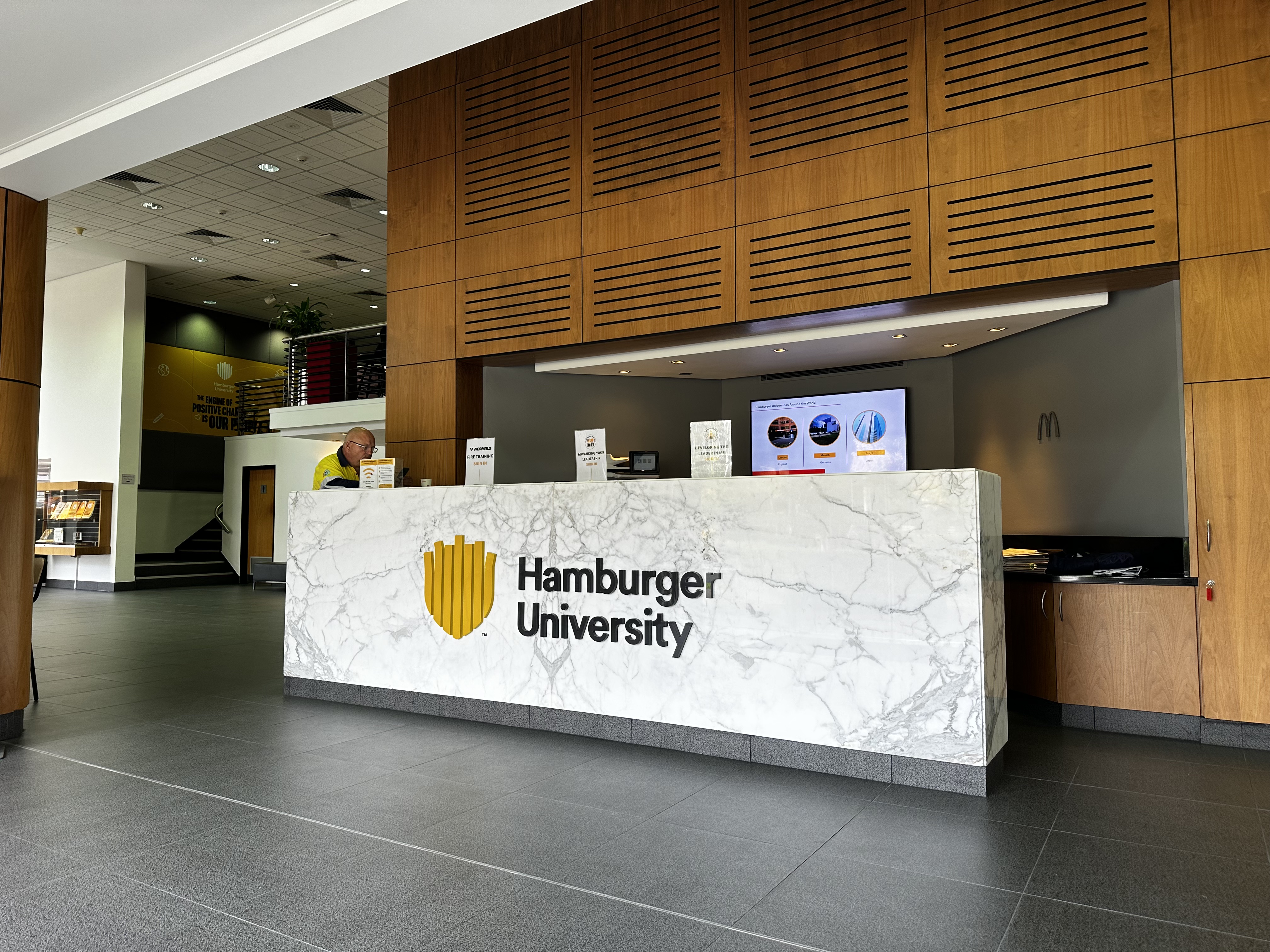
It's been more than three years since I completed my course, and to this day, I still find it hard to believe that I was once a Shift Manager.
While often underestimated, Shift Managers carry a tremendous amount of responsibility. In most cases, the Shift Manager is the highest-ranking team member on a shift, aside from Department Managers, Restaurant Managers, and Supervisors.
This means Shift Managers are responsible for things like:
- the general safety of the restaurant and its users, including staff and customers,
- ensuring compliance with rostered shifts and the work conducted by crew members,
- enforcing and maintaining Food Safety standards,
- managing restaurant profitability and cash accounting,
...on top of restaurant fundamentals like cleanliness, hygiene, and serving great-quality food.
Let's just say... being a Shift Manager can be stressful.
Imposter Syndrome
I still distinctly remember the handover on my very first shift as Shift Manager. I had the close. I was filled with self-doubt. Deep down, I didn't want the previous manager to leave. I had grown accustomed to having a more experienced, higher-ranking team member watching over everything.
There was also this strange juxtaposition between how I felt internally and what the world could see.
Customers just saw a figure in a grey shirt. They didn't know that it was my first shift.
My crew members knew that I had recently been promoted, but they also didn't know that this particular shift was my first.
So there was this strange reality where the only doubt in the world came from me. The only job left to do was to create the evidence and prove to myself that I was capable of leading a shift on my own.
3pm to 11pm. With the support of my team, we survived.
One shift after another, I slowly stopped counting. The narrative turned from being "only my nth shift as Shift Manager" to looking forward to my next shift as Shift Manager.
All Eyes Are on You
While I created many fond memories during my tenure as Shift Manager, I equally remember, and somewhat even cherish, the times that tested me and forced me to grow as a leader.
The toughest moments were often accompanied by huge doses of adrenaline and a sense of overwhelming doom and stress.
I would be standing at the bagging area, the "Observation Post" of the restaurant, and the sound of the new order alert would come non-stop, one after the other. Queuing customers would trickle through the door, densely packing the order pick-up zone.
The kitchen would be congested. "Holding on nuggets!" or "4 minutes on spicy" or "We're waiting on 10:1." The line would be full.
The drinks machine and station would overflow. We would run out of ice, again.
Customers would flag me and my already overwhelmed team members down and ask, "Could you please check on my order?"
And in all this chaos, we would run out of Apple Pies.
In these moments, it felt like all the customers in Sydney were staring at me. I would desperately hope that my Restaurant Manager or Supervisor would magically appear and save the day.
Of course, that never happens.
Instead, something different occurs. Almost as quickly as the chaos begins, it starts to subside. You do what your experience and training have taught you. Prioritise and execute. Keep serving orders, one after the other. Take things step by step.
Each time I was subjected to that kind of intense pressure, I progressively learnt to trust myself, and to trust my team. I had their backs, and they had mine.
Although Shift Managers are individually incredibly capable team members, we also learn to never take our best talent for granted. Just like as a crew member, the toughest rushes build rapport and trust between team members.
Each rush was a reminder of why what we do is so important. Procedures, restocking, proactive coaching, and mentorship — these are all things that set us up for success when things really get tough.
Memorable Moments
Here are a few things I look back on and think about from time to time.
Show, don't tell
A core part of why the McDonald's business is so successful is how systematic everything is. Procedures have been iterated upon and refined over decades of experimentation in restaurants.
Yet one of the hardest things about procedures is that they're meaningless if they're not followed.
One of the most commonly mis-followed procedures is how to cook 10:1 beef patties, the patties that go in Hamburgers, Cheeseburgers, and Big Macs.
The correct sequence is:
- Lay 6 beef patties on the grill from front to back, right to left.
- As soon as the grill platens are raised, season each beef patty with salt and pepper in the same order.
- Use the onion shaker in a hammer action to apply onions to each beef patty in the same order.
- Remove beef patties from the grill in the same order that they were laid down.
These procedures help ensure that all beef patties are cooked evenly and remain juicy and flavourful.
But sometimes, crew members are only human and get lazy. This means seasoning and onions would be skipped, and beef patties would sometimes sit on the grill for far too long or be removed in the wrong order, causing them to shrink and become dry and overcooked.
Of course, I could just tell my crew members to follow procedures. But instead, I chose to show them why those procedures existed in the first place.
So I cooked a run myself, following the procedures to a tee. I then took two 10:1 beef patties — one from my fresh batch, and another cooked by my crew from the UHC, the Universal Holding Cabinet where we temporarily store protein once it is cooked, and brought the team to the back office.
Taste test.
My team completely loved the flavour and juiciness of the properly cooked 10:1. They spat out their own cooking.
"Terry, I think you're onto something," they said.
I smiled.
From that day on, my team would always properly cook and season our beef patties. The best part? They took that lesson with them, and would always coach their fellow team members to follow procedures correctly. Sometimes, they would even ask if they could do a taste test with a new team member to show them why it matters.
They became stewards of the message itself. And that's why it pays to show, not tell.
Be humble
One of the core principles I had as a Shift Manager was that no task was beneath me.
Yes, delegation is important. But showing that you are there to help your team become the best versions of themselves matters too. This meant that I would often find myself helping restock the line, changing a bin, or mopping the floors.
These moments help reinforce two things.
Firstly, they show that you work alongside your team as a leader. Secondly, they serve as an opportunity to reinforce correct procedures by leading by example.
Honestly, I was disappointed when I heard a team member say, "Terry, I think this is the first time I've ever seen a manager mop." It was a powerful reminder that sometimes, leaders and managers can forget what they're truly there for.
To work together with their teams, empower them, and lead by example.
Another variation of this is doing certain tasks together with team members.
Things like changing the outside bin, or refilling the ice in the Automated Beverage System. These little moments are an extra touchpoint to check in with your team and build rapport. They give you a rare chance to interact one-on-one and hear what your crew members really think and feel when they're working on one of your shifts.
Interviewing is hard
In addition to shaping the culture directly while on shift, another responsibility of Shift Managers involves interviewing prospective candidates.
While I'm proud of the near perfect track record I had with the candidates I recommended hiring, it always irks me when I consider the rare outlier and how they might have managed to slip through the cracks.
I recall one candidate who had a lot of diverse experience. Some in hospitality, some in construction. I was impressed, so I recommended that we hire them. However, cracks soon started to appear when this person just wouldn't show up to shifts, and would often provide obscure reasons for needing to replace their shifts, often at the last moment too.
I learnt that while experience can be a great sign, too much experience at such a young age — recall, McDonald's primarily hires young adults — might not necessarily be a green flag. Instead, many who find themselves working at Maccas are often starting their very first job.
Another candidate was once incredibly honest. Their reason for applying to McDonald's was something along the lines of, "My parents say I spend too much time at home sitting on the couch, and told me to apply for jobs." Mind you, this was someone still in high school.
On the one hand, I truly appreciated their honesty and could empathise with their situation. I distinctly remembered how Maccas had inspired me, even when it was something I had never expected to do. But on the other hand, I felt that there was a complete lack of trying on their part. A lack of determination to at least try to present themselves as a great candidate for the job.
I didn't hire that candidate.
To this day, I'm not sure — and I'll never know — if that was the right decision. Sometimes, I feel like we should give people a chance and an environment to thrive. But with the volume of applicants in a business like Maccas, we really can't expect to do that for everyone. The least you can do as a candidate is try.
People First
Cringe as it may be, my journey to becoming a Shift Manager, and growing in the role, is truly one that has shaped me in notable ways.
It's a chapter that I'm incredibly grateful for, and I clearly remember each and every Crew Member, Crew Coach, and Manager who influenced me and taught me something along the way.
If there's one framing I'll never forget, it's this:
McDonald's isn't a burger business serving people. It's a people business serving burgers.
Put your people first. Always.